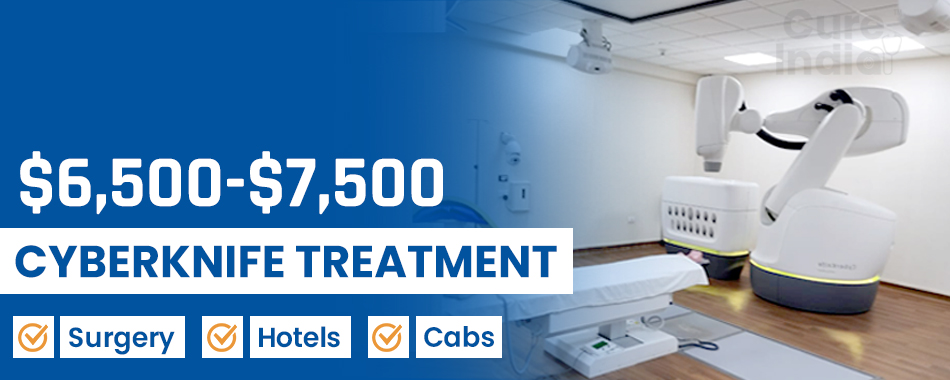
CyberKnife Treatment Cost in India - Best Doctors & Top Hospitals
CyberKnife is actually the brand name of the medical equipment that is responsible for providing the body stereotactic body radiation therapy (SBRT) that is used to kill the cancer cells. CyberKnife treatment is sone external by using external beam radiation. CyberKnife treatment mostly adopted for prostate cancer treatment but also other types of cancer.
CyberKnife may consist of the word “knife”, but there are no cuts or incisions, and it is a minimally invasive procedure, which also sometimes called “radiosurgery”, the only robotic procedure to treat cancer cells or tumors in the body through non-invasive procedures.
SBRT deliver large doses of intense radiation to accurately hit the tumor cells. This is done by using the image-guided technique so that only cancer cells are killed while avoiding any damage to the other healthy tissues and organs.
Because the SBRT technique that the CyberKnife treatment uses, which targets particular areas containing the tumor, CyberKnife treatment is comparatively better than the conventional radiation therapy as the former takes few days while the latter can take as much as eight to nine weeks of treatment to get complete.
CyberKnife Treatment Candidacy
CyberKnife treatment is a very good option for those diagnosed with an early stage prostate cancer. Sometimes the CyberKnife treatment is also combined with other forms of cancer treatments like hormone therapy if cancer has progressed and spread to other tissues as well.
Sometimes CyberKnife treatment is also used in cancer patients who have reached an advanced stage, CyberKnife treatment can retard the progression of cancer cells to the neighbouring tissues.
Advantages of CyberKnife treatment over Traditional Treatments
There are some advantages of CyberKnife treatment over other traditional treatments like chemotherapy, radiation therapy etc. They are:
- CyberKnife treatment procedure does not involve any incisions or pain, in comparison to the cancer surgery.
- You may not need anaesthesia and can be discharged the same day.
- After the CyberKnife treatment procedure, you can resume your normal activities.
- CyberKnife treatment takes lesser time than conventional radiation or chemotherapy.
- The recovery period is fast and doesn't take additional time, like chemotherapy and radiotherapy do.
Another type of radiation used for prostate surgery is Tomotherapy radiation treatment which uses intensity modulated radiation therapy (IMRT), which delivers the radiation to the cancer spot in slices. The word Tomotherapy has emerged from a Greek prefix – tomo, which means slice.
Tomotherapy treatment is similar to CyberKnife treatment technique as it uses powerful and precise radiation beams to hit the inoperable tumors without damaging healthy tissues. The inbuilt CT scanning in the IMRT aids in determining the size and position of the tumor before the tomotherapy treatment starts.
CyberKnife Treatment Procedure
Before the getting started with the CyberKnife treatment, the doctor will first run tests like MRI, CT or CT/PET scan is taken in order to assess the size, shape and location of the tumor. After which, you will be placed on the table in a specific position. You’ll be placed in the proper position on a table. After you take your position, a computer-controlled robot will be moving around the table you are placed on and will detect and throw radiation on the sites specifically containing the tumor. The robotic software will automatically adapt and adjust the radiation according to your breathing pattern and any movement of the tumor.
Each CyberKnife treatment session takes around 30 to 90 minutes to complete after which you are discharged the same day and are allowed to resume your normal activities right away.
CyberKnife Cost in India
The CyberKnife treatment in India costs you around 6,500-7,500 USD. This cost is 70-80% cheaper than the cost in the USA. Additionally, there will be no compromise on global-standard treatment quality that you find in the US.
The CyberKnife treatment cost varies depending upon the doctors, the best hospitals in India for CyberKnife treatment, and how severe your condition is and the city. Also, you must be aware that the CyberKnife cost also varies depending upon the type of condition you might be having.
| Type |
Sessions |
Cost Range |
| Brain Tumors / Metastases |
1 to 3 Sessions |
$6,500 – $8,000 |
| Prostate Cancer |
5 Sessions |
$6,500 – $9,500 |
| Lung Cancer (SBRT tracking) |
3 to 5 Sessions |
$5,800 – $8,500 |
| Spine & Liver Tumors |
3 to 6 Sessions |
$6,000 – $9,000 |
What Is Included in the CyberKnife Treatment Cost in India?
The following list of items is included when you come to India for CyberKnife treatment.
| Included Things |
Details |
| Consultation |
Your consultations with a Radiation oncologist |
| MRI / CT Planning |
Diagnostic tests before the surgery are covered by cost. |
| CyberKnife Sessions |
All prescribed sessions are suggested by your doctor. |
| Treatment Planning |
Tumor mapping and dose planning |
| Follow-up Consultation |
Initial post-treatment review |
Note: Additional medical costs outside the treatment plan are not covered.
Factors Influencing Cyberknife Treatment Cost in India
There are various factors that influence actual costs that you will be required to pay. Some of them are discussed below:
- Pre-operative tests: Patients undergo tests such as MRI or CT scans. This helps the radiation oncologists to know the exact location and severity of the tumor.
- Hospital: Depending upon the type of hospital a patient chooses, costs vary accordingly.
- Number of sessions: Cyberknife is an outpatient procedure. However, the total number of sessions you take determines the actual cost.
- Severity of the tumor type: The number of sessions also depends on how severe your tumor type is, thereby influencing costs.
- City: The Gurgaon and Delhi NCR regions are usually preferred by international patients. Gurgaon is the medical tourism hub of the country.
Cyberknife Treatment Cost Comparison in Top Medical Tourism Countries
CyberKnife treatment cost in India is the lowest amongst top medical-tourism countries.
| Country |
Cost |
Waiting time |
Strategy & Technique |
Clinical Outcomes |
Follow-up Support |
| USA |
$50,000 – $100,000 |
12-16 weeks |
Premium but restricted by hospital laws |
95% for 5-year disease-free survival depending upon tumor type and severity |
Poor due to cross-border medical licensing laws |
| Germany |
$30,000 – $45,000 |
4-8 weeks |
Highly structured treatment and less personalized care reported by patients |
90% to 95% local tumor control rates |
Structured but language barriers obstruct proper communication. |
| Thailand |
$10,000 – $19,000 |
2-3 weeks |
Standard but less specialized due lower treatment volumes at dedicated CyberKnife centers |
Suitable mostly for routine cases |
Lack of dedicated portals |
| UK |
$25,000 – $40,000 (Private) |
2-4 weeks |
Excellent but gated by trial rules |
Good outcomes in specialized centers |
Limited ongoing support at home country |
| Turkey |
$10,000-$12,000 |
2 weeks |
Less specialized multi-session strategy |
Limited experience in certain complex tumors |
Translator friction and slow turnaround times on scan reviews |
| India |
6,500-7,500 USD |
Immediate to 2 days |
Elite Technological Mastery, due to high treatment volumes performed by Indian radiation oncologists annually |
Globally benchmarked excellence and favorable outcomes were reported in selected patients depending on tumor type and stage. |
Seamless Global Continuity: video consultations, lifetime digital uploads of follow-up scans, and minimal extra cost. |
Who Is a Good Candidate for CyberKnife Treatment?
If you have any of the following issues or medical conditions, you need to consult a doctor for proper diagnosis.
- Brain tumors
- Prostate cancer
- Lung tumors
- Spine tumors
- Liver tumors
- Patients unfit for surgery
There are many doctors for CyberKnife treatment in India. However, as per patient recommendations and satisfaction rates, Dr. Aditya Gupta and Dr. V.P. Singh are widely regarded as the most respected name for CyberKnife treatment in India.
Why Do International Patients Choose India for CyberKnife Treatment?
Lower costs in India are not due to compromise on treatment standards or quality. Patients choose India because Indian hospitals and doctors follow the JCI standard and patient safety goals. Costs in India are affordable due to lower operational costs, cost of living, and high volume of CyberKnife treatments performed by Indian radiation oncologists.
- World-class treatment at affordable costs
- Global standard facilities at JCI-accredited hospitals
- High success rate due to high volume of CyberKnife treatments performed in India
- No waiting times and immediate treatment in most of the cases
- Many radiation oncologists and cancer specialists in India hold international fellowships and training credentials
- Complete medical tourism support
Your Travel Plan to India
While CyberKnife is a non-invasive outpatient procedure, most international patients are advised to remain under observation before receiving fit-to-fly clearance. The best CyberKnife doctors in India leave no stone unturned to check your condition before giving a fit-to-fly clearance.
| Timeline |
Event |
| Arrival (Days 1 to 3) |
You will undergo high-resolution MRI or PET-CT scans to locate the tumor. |
| Treatment (Days 4 to 8) |
You will undergo CyberKnife sessions that last between 30 and 90 minutes. You can return to your hotel after the session if your doctor suggests. |
| Observation (Days 9 to 12) |
The medical team will monitor your condition for any complications or any other medical problems. |
| Flight Clearance (Days 13 to 15) |
You only get a formal "Fit-to-Fly" certificate issued when your condition is stable. |
| Follow-up (when required) |
You can follow up with your treating doctor digitally for any queries you have in your home country. Patients generally do it via video consultations. |
Note: Duration may vary depending on the treatment plan and physician recommendations
CyberKnife vs Surgery
CyberKnife is a non-invasive treatment that does not require any incisions, unlike traditional surgery. Most patients do not need a hospital stay and can return to their hotel or home shortly after the treatment session. There is usually minimal pain or discomfort because no cuts or stitches are involved.
In contrast, surgery typically requires an incision, anesthesia, and a hospital stay for recovery. Recovery after CyberKnife treatment is generally faster, allowing many patients to resume their daily activities sooner. However, the most suitable option depends on the type, size, and location of the tumor, as well as the recommendation of the treating specialist.
CyberKnife FAQs
A study titled "CyberKnife Stereotactic Radiosurgery in Brain Metastases," published in 2018, evaluated 49 patients with 152 brain metastases treated using CyberKnife. Researchers reported a 1-year local tumor control rate of 90%, suggesting favorable tumor control outcomes in appropriately selected patients.
While there are side effects of cyberknife surgery like any other surgery, your doctor will prepare the best treatment plan and recovery roadmap for you to minimize the risk of any complications after you fly to your home country.
Most medical tourists choose India for CyberKnife treatment in India because of the low cost in India. This low cost is not because of compromised quality of treatment but due to lower cost of living and affordable operational charges.
Yes, CyberKnife is used to treat stage 4 cancer. While there is no cure, doctors use it effectively to manage the symptoms and improve the quality of life.


 +918448560641