




Breast Cancer Survival Rate in India
A diagnosis of breast cancer raises one of the first and most important questions for every patient and family: What are the chances of survival? While no doctor can predict an individual's outcome with certainty, decades of research show that survival is influenced by factors such as the stage at diagnosis, tumour biology, and timely access to evidence-based treatment.
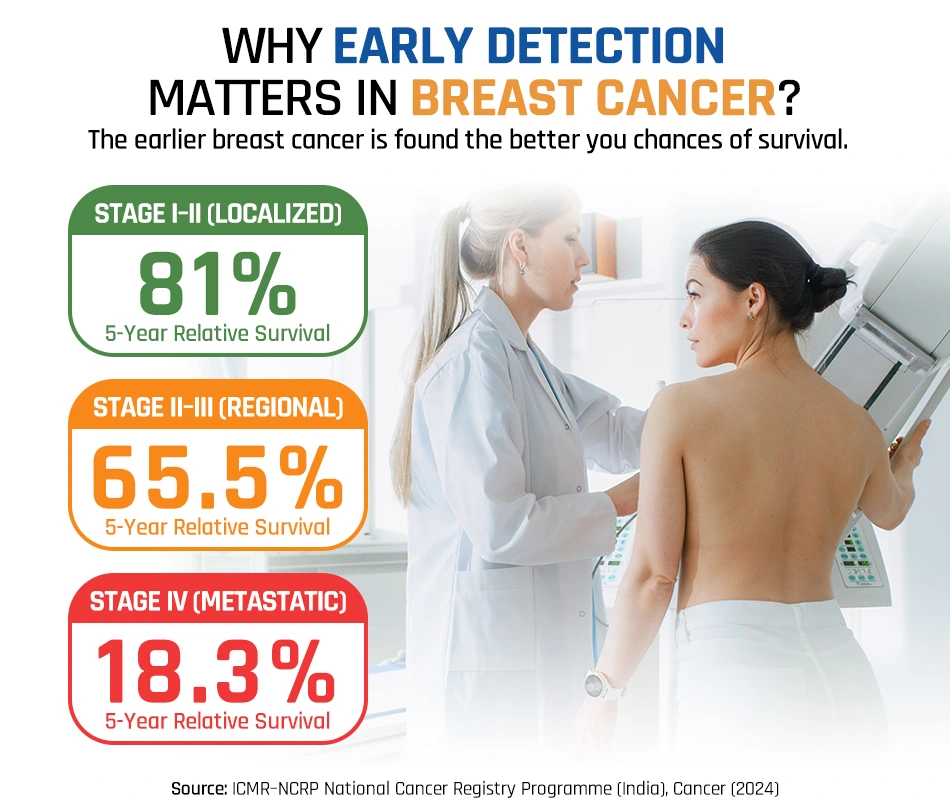
For international patients considering treatment in India, survival statistics should be interpreted as population-based estimates rather than an individual's prognosis. According to the Indian Council of Medical Research (ICMR) through the National Cancer Registry Programme (NCRP), the largest population-based breast cancer survival study in India evaluated 17,331 women across 11 Population-Based Cancer Registries and reported an overall 5-year age-standardized relative survival rate of 66.4%. Survival was highest for localized breast cancer (81.0%) and declined with regional (65.5%) and metastatic disease (18.3%), highlighting the importance of early diagnosis and timely treatment.
This article reviews the latest evidence on the breast cancer survival rate in India, explains how survival is measured, compares outcomes by disease stage, and discusses the key factors that influence long-term prognosis.


What Is the Breast Cancer Survival Rate in India?
Breast cancer survival is commonly reported as the 5-year relative survival rate, an internationally accepted measure used by cancer registries to compare the survival of people diagnosed with breast cancer with that of the general population. It provides an overall estimate of cancer outcomes at the population level rather than an individual's prognosis.
The strongest evidence for India comes from the Indian Council of Medical Research (ICMR) through the National Cancer Registry Programme (NCRP). Published in the peer-reviewed journal Cancer, this landmark study evaluated 17,331 women diagnosed with breast cancer between 2012 and 2015 across 11 Population-Based Cancer Registries (PBCRs) and followed their outcomes until June 2021.
The study reported an overall 5-year age-standardized relative survival rate of 66.4% (95% CI: 65.5%–67.3%). Survival varied according to the extent of disease at diagnosis:
| Extent of Disease at Diagnosis | 5-Year Relative Survival Rate |
|---|---|
| Localized Breast Cancer | 81.0% |
| Regional Disease | 65.5% |
| Distant (Metastatic) Breast Cancer | 18.3% |
These findings are consistent with recommendations from the World Health Organization (WHO), American Society of Clinical Oncology (ASCO), and European Society for Medical Oncology (ESMO), which emphasize that earlier diagnosis and timely evidence-based treatment are key determinants of improved breast cancer survival. They are also broadly aligned with the CONCORD-3 global cancer survival programme, which reported similar population-based survival estimates for India while highlighting the impact of early detection and access to comprehensive cancer care on long-term outcomes.
That is why it is of utmost importance for women to be aware of the signs and symptoms of breast cancer and causes of breast cancer in women for early treatment and proper prognosis.
How Has Breast Cancer Survival in India Evolved Over the Years?
India's understanding of breast cancer survival has evolved from small city-based registry studies to large nationwide population-based analyses conducted through the Indian Council of Medical Research (ICMR) National Cancer Registry Programme (NCRP). This progression has provided increasingly reliable evidence on breast cancer outcomes across the country.
Early Population-Based Evidence (1995–1997)
One of India's earliest landmark studies was conducted by the Bangalore Population-Based Cancer Registry, which evaluated 1,514 women diagnosed between 1982 and 1989. The investigators reported a 5-year relative survival rate of 46.8% and identified the stage at diagnosis as the strongest predictor of survival.
Soon afterwards, the Madras Metropolitan Tumour Registry (MMTR) analyzed 2,080 women with invasive breast cancer and reported a 5-year relative survival rate of 51%. The study further showed that earlier-stage disease, younger age, and higher educational status were associated with improved survival, emphasizing the importance of early diagnosis and coordinated cancer care.
Expansion of India's Cancer Registry Network
Since its establishment in 1981, the ICMR National Cancer Registry Programme (NCRP) has expanded from a handful of registries to one of Asia's largest cancer surveillance networks. Today, it coordinates numerous Population-Based Cancer Registries (PBCRs) and Hospital-Based Cancer Registries (HBCRs) across India, collecting standardized data on cancer incidence, treatment, and survival.
This expansion has significantly strengthened the reliability of breast cancer survival estimates. Unlike earlier studies limited to individual cities, modern NCRP analyses combine data from multiple regions using standardized registration and follow-up methods, providing a more representative picture of breast cancer outcomes nationwide. The programme also follows internationally recognized cancer registration standards developed by the International Agency for Research on Cancer (IARC), further enhancing the credibility of India's survival data.
For international patients, this evolution means that breast cancer survival estimates in India are now based on robust nationwide population data rather than isolated hospital or city-specific studies, providing a more reliable assessment of long-term outcomes.
What Do These Findings Mean for International Patients?
Although these studies span different time periods and cannot be compared directly because of changes in cancer registration, staging, and treatment, they demonstrate a clear trend: India's breast cancer survival evidence has become increasingly robust through nationwide population-based registries. At the same time, advances in diagnosis and evidence-based treatment have contributed to improved patient outcomes.
Why Has Breast Cancer Survival Improved Over the Last Three Decades?
Several advances in modern oncology have significantly improved breast cancer survival worldwide:
■ Earlier Detection and Diagnosis:
Improvements in breast imaging, image-guided biopsy, standardized pathology, and biomarker testing (ER, PR, HER2) enable earlier diagnosis and more personalized treatment. The WHO Global Breast Cancer Initiative identifies early detection, timely diagnosis, and comprehensive treatment as the three pillars for reducing breast cancer mortality.
■ Multidisciplinary Care:
International guidelines from ASCO, ESMO, and the NCCN recommend treatment planning by multidisciplinary teams to ensure individualized, evidence-based care.
■ Advances in Surgery and Radiotherapy:
Breast-conserving surgery with sentinel lymph node biopsy has reduced surgical morbidity without compromising cancer control. In addition, the landmark EBCTCG meta-analysis showed that adjuvant radiotherapy after breast-conserving surgery significantly reduced local recurrence and breast cancer mortality.
■ Precision Medicine and Targeted Therapy:
Routine ER, PR, and HER2 testing allows treatment to be tailored to tumour biology. Landmark trials such as HERA, NSABP B-31, and NCCTG N9831 established HER2-targeted therapy as a standard of care, substantially improving survival for HER2-positive breast cancer.
■ Immunotherapy:
More recently, the KEYNOTE-522 trial demonstrated that adding pembrolizumab to chemotherapy improves outcomes in selected patients with high-risk early-stage triple-negative breast cancer (TNBC), leading to its incorporation into international treatment guidelines.
Together, these advances have transformed breast cancer management over the past three decades, making survival today a reflection of earlier diagnosis and continual improvements in evidence-based treatment rather than any single intervention.
Read about the latest breast cancer screening methods to stay updated with the evolution of new options for breast cancer treatment.
Breast Cancer Survival by Stage
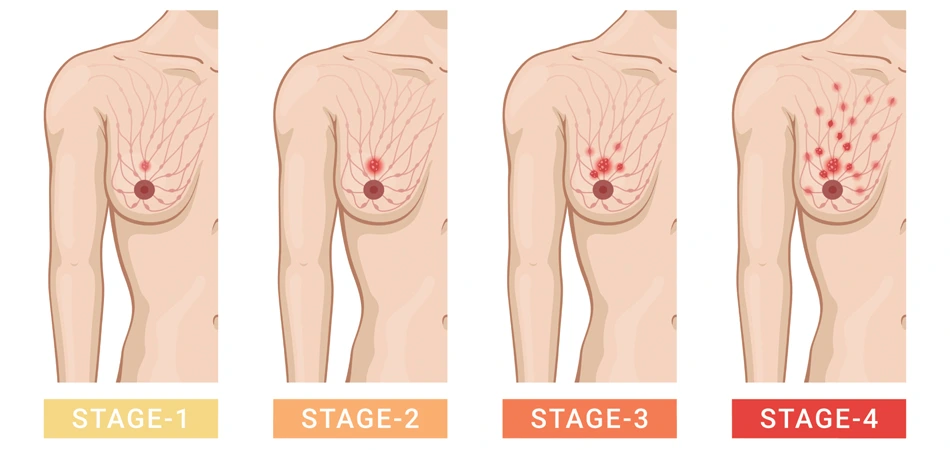
Breast cancer survival rates are highly dependent on early detection and the extent of the spread at diagnosis.
| Extent of Disease / Stage* | Typical Clinical Stage | 5-Year Relative Survival | Clinical Interpretation |
|---|---|---|---|
| Localized | Stage 0–II (confined to the breast) | 81.0% (India) / 99.0% (SEER) | Highest survival because the cancer has not spread beyond the breast. Early diagnosis and timely treatment offer the best long-term outcomes. |
| Regional | Stage II–III (spread to nearby lymph nodes) | 65.5% (India) / 87.5% (SEER) | Survival decreases once regional lymph nodes are involved, but many patients can still achieve long-term disease control with multimodality treatment. |
| Distant (Metastatic) | Stage IV (spread to distant organs) | 18.3% (India) / 33.8% (SEER) | Metastatic breast cancer is generally not considered curable, although advances in targeted therapy, endocrine therapy, and immunotherapy have significantly improved survival for many patients. |
*Note: Population-based registries such as ICMR–NCRP and SEER classify survival using localized, regional, and distant disease rather than exact AJCC stages. Stage 0–IV shown here is an approximate clinical mapping to help readers understand the disease extent.
Key Takeaway
The earlier breast cancer is diagnosed, the higher the chance of successful treatment and long-term survival.
Long-Term Survival Outcomes in Early-Stage Breast Cancer: Evidence from an Indian Prospective Study
This prospective Indian study evaluated the 10-year outcomes of women with early-stage (Stage I–II) breast cancer treated under a comprehensive multidisciplinary breast cancer program. The findings suggest that early diagnosis, guideline-based treatment, and coordinated multidisciplinary care can achieve excellent long-term survival, highlighting the value of organized breast cancer care in improving patient outcomes.
| Key Parameter | Findings |
|---|---|
| Study Design | Prospective cohort study |
| Study Period | 2008–2018 |
| Study Population | 185 women with Stage I–II breast cancer |
| Follow-up | Up to 10 years |
| 5-Year Overall Survival | 85.2% |
| 10-Year Overall Survival | 79.0% |
| 5-Year Disease-Free Survival | 84.6% |
| 10-Year Disease-Free Survival | 76.2% |
Key Insights
- Patients were treated using a multidisciplinary approach, including surgery, chemotherapy, radiotherapy, hormone therapy, and HER2-targeted therapy when indicated.
- Earlier-stage diagnosis was associated with better long-term survival, reinforcing the importance of early detection and timely treatment.
- The study demonstrates that specialized comprehensive breast cancer programs in India can achieve long-term survival outcomes that compare favorably with broader national registry data, emphasizing the impact of coordinated, evidence-based care rather than any single treatment modality.
Source: Ten-year survival in early-stage breast cancer patients in a comprehensive breast cancer care program in India | View Study
Breast Cancer Survival by Molecular Subtype
Breast cancer is classified into several molecular subtypes based on hormone receptor (ER/PR) and HER2 status. These subtypes differ in their biological behavior, treatment options, and overall prognosis.
| Molecular Subtype | Prognosis | Why? |
|---|---|---|
| Luminal A | Most favorable | Slow-growing and highly responsive to hormone (endocrine) therapy. |
| Luminal B | Good | Grows faster and is more aggressive than Luminal A, but remains responsive to systemic therapies and hormone treatment. |
| HER2-positive | Significantly improved | Historically aggressive, but modern HER2-targeted agents (such as trastuzumab and pertuzumab) have radically transformed long-term outcomes. |
| Triple-negative (TNBC) | Less favorable | More aggressive with a higher risk of early recurrence, though the addition of immunotherapy and targeted agents has noticeably improved response rates. |
Why Do Breast Cancer Survival Rates Vary Between Patients?
The overall 5-year breast cancer survival rate reflects outcomes across a population but does not predict an individual patient's prognosis. According to leading oncology organizations, including the World Health Organization (WHO), survival is influenced by a combination of biological and clinical factors rather than a single statistic.
The stage at diagnosis remains the strongest predictor of survival. Women diagnosed when the cancer is confined to the breast generally have substantially better outcomes than those diagnosed after it has spread to regional lymph nodes or distant organs. The WHO also identifies early detection, prompt diagnosis, and comprehensive treatment as the three key pillars for improving breast cancer survival.
Beyond disease stage, several tumor- and patient-related factors influence prognosis, including:
- Tumour grade
- Lymph node involvement
- Estrogen receptor (ER) status
- Progesterone receptor (PR) status
- HER2 status
- Triple-negative breast cancer (TNBC)
- Patient age and overall health
- Response to treatment
These factors help oncologists personalize treatment and estimate prognosis for each patient. As recommended by ASCO and ESMO, treatment decisions are based on tumor biology and disease stage rather than a one-size-fits-all approach. Consequently, two women with the same diagnosis may have different outcomes depending on their cancer characteristics and how early evidence-based treatment begins.
You might be wondering: What Does a Breast Tumor Look and Feel Like, and How to Self-Examine? Read the blog. Awareness is the first step to treatment.
How Is Breast Cancer Survival Measured?
Breast cancer survival is reported using several statistical measures in clinical research.
The most common is the 5-year relative survival rate, which compares the survival of women diagnosed with breast cancer with that of women of the same age in the general population.
Clinical trials may also report overall survival (OS), disease-free survival (DFS), or progression-free survival (PFS), each measuring different treatment outcomes.
Understanding these terms helps patients interpret survival statistics correctly and compare results across studies.
How Can Breast Cancer Survival be Improved?
Apart from medical factors, there are a number of lifestyle factors that patients with breast cancer must be aware of.
Studies have shown that body weight influences the treatment of breast cancer. Women with higher weight before and after breast cancer have a higher risk of a poorer prognosis. Obesity may or may not be a direct factor for every woman with breast cancer; specialists and doctors encourage patients to maintain an ideal weight.

According to the Canadian Cancer Society and the American Cancer Society, exercising or physical activity decreases the chances of recurrences. Women are advised to perform at least 150 minutes of moderate-intensity aerobic exercise each week (such as 30 minutes on five days) or 75 minutes of vigorous-intensity activity. In addition, strength-training exercises targeting all major muscle groups should be included two to three times per week.
Research suggests that dietary habits, particularly a high intake of saturated fats and high-fat dairy products, may be associated with an increased risk of breast cancer recurrence and mortality. However, factors such as body weight and physical activity can influence these findings, making it difficult to determine the exact role of diet. Clinical studies indicate that reducing dietary fat intake may help lower the risk of breast cancer recurrence, although the benefits may also be partly related to weight loss.
No single diet has been proven to reduce the risk of breast cancer recurrence more effectively than others. However, Mediterranean-style dietary patterns, particularly when combined with regular physical activity, have shown encouraging results for improving breast cancer survival, although more research is needed.
Current evidence does not support avoiding soy after a breast cancer diagnosis. In fact, moderate consumption of soy foods may be safe and could be associated with a lower risk of breast cancer recurrence, although more high-quality clinical trials are needed to confirm these benefits.
Smoking after a breast cancer diagnosis is associated with higher breast cancer mortality, making smoking cessation strongly recommended for overall health, even though its effect on recurrence remains uncertain. Evidence on alcohol is mixed, but limiting intake to one or fewer drinks per day is advised, particularly for women with estrogen receptor–positive breast cancer.
Current evidence does not support routine vitamin supplementation to improve breast cancer outcomes. While adequate vitamin C and vitamin D levels may be associated with better survival, and vitamin E has shown no clear benefit, more randomized clinical trials are needed to confirm these findings.
Breast cancer survival has improved because of advances in surgery, radiotherapy, systemic therapies, and personalized treatment planning. Depending on the stage and molecular subtype of the disease, your oncologist may recommend mastectomy, Intensity-Modulated Radiotherapy (IMRT), chemotherapy, hormone therapy, targeted therapy, or immunotherapy as part of a comprehensive treatment plan.
Breast Cancer Treatment Cost in India
| Treatment Type | Estimated Cost in India (USD) | Estimated Cost in USA (USD) |
|---|---|---|
| Surgery (Mastectomy/Lumpectomy) | $2,000-$1,000 | $20,000-$50,000 |
| Chemotherapy (per cycle) | $200-$2,500 | $5,000-$10,000 |
| Radiation Therapy (Full Course) | $1,500-$3,000 | $10,000-$20,000 |
| Full Treatment Plan (Avg Total) | $3,000-$11,000 | $45,000-$100,000 |
Note: The total expenses are highly dependent on the stage of the cancer, hospital chosen, and surgeon expertise.
How is India at the Forefront of Breast Cancer Treatments?
Major Indian cancer centers follow internationally recognized treatment guidelines from ASCO, ESMO, and NCCN, while also adapting care to Indian patients through the latest Association of Breast Surgeons of India (ABSI) consensus guidelines.
Find below the reasons why international patients respect India's having evidence-based treatment following global standards for breast cancer.
■ Comprehensive Multidisciplinary Breast Cancer Care
Patients are increasingly managed by multidisciplinary teams comprising breast surgeons, medical oncologists, radiation oncologists, radiologists, pathologists, genetic counselors, and reconstructive surgeons, enabling personalized treatment planning in line with global best practices.
Leading breast cancer surgeons in India such as Dr. Mandeep Singh Malhotra and Dr. Rohan Khandelwal are internationally recognized for their personalized and precision care.

■ Precision Oncology and Genomic Profiling
Leading breast cancer hospitals in India and renowned Indian institutions now routinely use molecular profiling, hormone receptor testing (ER/PR), HER2 testing, and next-generation sequencing for selected patients to personalize targeted therapies and improve treatment selection.
■ Internationally Recognized Breast Cancer Research
Indian researchers are making significant contributions to global breast cancer science.
■ Rapid Adoption of Targeted Therapy and Immunotherapy
Modern treatment options—including HER2-targeted drugs, CDK4/6 inhibitors, PARP inhibitors for selected patients, antibody-drug conjugates, and immunotherapy for eligible triple-negative breast cancer—are increasingly available at major oncology centers across India.
■ Advanced Breast-Conserving and Oncoplastic Surgery
Specialized breast surgeons increasingly perform breast-conserving surgery with sentinel lymph node biopsy and oncoplastic reconstruction, helping achieve excellent cancer control while preserving cosmetic outcomes whenever clinically appropriate.
■ Expansion of Robotic and Minimally Invasive Breast Surgery
Indian cancer centers continue to adopt advanced robotic-assisted breast surgery and minimally invasive techniques, improving surgical precision and supporting faster recovery in selected patients.
■ Affordable Clinical Research with Global Impact
India has demonstrated that affordable treatment innovations can improve survival.
■ Strong National Cancer Research Infrastructure
Organizations in India are expanding India's cancer genomics and translational research to improve understanding of breast cancer biology in patients.
■ Growing Focus on Standardized, High-Quality Cancer Care
Leading institutions are driving nationwide initiatives to standardize breast cancer treatment protocols, reduce variations in care, and improve access to evidence-based management across the country.
Conclusion
Breast cancer survival in India has improved considerably over the past three decades because of advances in early detection, standardized pathology, surgery, radiotherapy, systemic therapies, and multidisciplinary cancer care. The latest ICMR-NCRP population-based study provides the strongest evidence currently available, while international guidelines from WHO, ASCO, and ESMO emphasize that survival depends on timely diagnosis and evidence-based treatment. Although national survival statistics provide valuable benchmarks, an individual's prognosis is influenced by several clinical and biological factors. Patients considering treatment in India should discuss their specific stage, tumour biology, and treatment options with an experienced multidisciplinary oncology team to obtain the most accurate assessment of their expected outcome.
Glossary
- Age-standardized survival rate: A way of comparing survival rates fairly between groups of people with different ages.
- Biomarker: A feature in cancer cells that helps doctors choose the best treatment.
- Biopsy: Removing a small piece of tissue to check for cancer under a microscope.
- Breast-conserving surgery (Lumpectomy): Surgery that removes the cancer while keeping most of the breast.
- Cancer Registry: A database that collects information about people diagnosed with cancer.
- Clinical Trial: A research study that tests whether a new treatment is safe and effective.
- Disease-Free Survival (DFS): The length of time a person remains free from cancer after treatment.
- Endocrine (Hormone) Therapy: Medicines that block hormones to slow or stop certain breast cancers.
- Estrogen Receptor (ER): A protein on some breast cancer cells that allows them to grow using estrogen.
- Evidence-Based Treatment: Treatment based on the best available scientific research.
- HER2: A protein that can make some breast cancers grow faster.
- Hormone Receptors (ER/PR): Proteins on cancer cells that help doctors decide whether hormone therapy will work.
- Immunotherapy: Treatment that helps the body's immune system fight cancer.
- Lymph Nodes: Small glands that help fight infections and can also be a place where cancer spreads.
- Metastatic Breast Cancer: Breast cancer that has spread to other parts of the body.
- Multidisciplinary Team (MDT): A group of different medical specialists who work together to plan treatment.
- Overall Survival (OS): The percentage of patients who are still alive after a certain period of time.
- Pathology: The study of tissues and cells to diagnose diseases such as cancer.
- Population-Based Study: A study that includes many people from a community or country, not just one hospital.
- Precision Medicine: Choosing treatment based on the unique features of a person's cancer.
- Progression-Free Survival (PFS): The length of time a patient lives without the cancer getting worse.
- Prognosis: The doctor's estimate of how a disease is likely to progress or respond to treatment.
- Radiotherapy: Treatment that uses high-energy rays to destroy cancer cells.
- Relative Survival Rate: The percentage of people with cancer who are still alive after a certain number of years compared with people without cancer.
- Sentinel Lymph Node Biopsy: A test that checks the first lymph node where cancer is most likely to spread.
- Stage of Cancer: A description of how large the cancer is and whether it has spread.
- Systemic Therapy: Treatment, usually medicines, that travels through the body to kill cancer cells wherever they are.
- Targeted Therapy: Medicines that attack specific proteins or genes that help cancer grow.
- Triple-Negative Breast Cancer (TNBC): A type of breast cancer that does not have ER, PR, or HER2 proteins, making it harder to treat with hormone or HER2-targeted medicines.
- Tumour Biology: The characteristics of a tumour that determine how it grows and responds to treatment.
- Tumour Grade: A measure of how abnormal the cancer cells look and how quickly they are likely to grow.
Breast Cancer FAQs
Can breast cancer be cured completely?
Can you live for 20 years after stage 3 breast cancer?
What is the deadliest stage of breast cancer?
How long does it take for breast cancer to go from stage 1 to stage 4?
What age is common for breast cancer?
Is stage 4 breast cancer 100% death?
What organ is most affected by breast cancer?
How fast can breast cancer spread to bones?
Is chemo worth it for stage 4 breast cancer?
References
■ Sathishkumar K, Sankarapillai J, Mathew A, et al. Breast cancer survival in India across 11 geographic areas under the National Cancer Registry Programme. Cancer. 2024;130(10):1816-1825. doi:10.1002/cncr.35188
■ Nandakumar A, Anantha N, Venugopal TC, Sankaranarayanan R, Thimmasetty K, Dhar M. Survival in breast cancer: a population-based study in Bangalore, India. Int J Cancer. 1995;60(5):593-596. doi:10.1002/ijc.2910600504
■ Gajalakshmi CK, Shanta V, Swaminathan R, Sankaranarayanan R, Black RJ. A population-based survival study on female breast cancer in Madras, India. Br J Cancer. 1997;75(5):771-775. doi:10.1038/bjc.1997.137
■ Hensing W, Santa-Maria CA, Peterson LL, Sheng JY. Landmark trials in the medical oncology management of early stage breast cancer. Semin Oncol. 2020;47(5):278-292. doi:10.1053/j.seminoncol.2020.08.001
■ World Health Organization. Global Breast Cancer Initiative.
■ World Health Organization. Global Health Observatory: Breast Cancer Survival Data.
■ International Agency for Research on Cancer (IARC). Global Cancer Observatory.
■ Global Initiative for Cancer Registry Development (GICR). Cancer Registry Data Hub.
■ Early Breast Cancer Trialists' Collaborative Group (EBCTCG). Overview of Randomized Trials in Early Breast Cancer.
■ Early Breast Cancer Trialists' Collaborative Group (EBCTCG), Darby S, McGale P, et al. Effect of radiotherapy after breast-conserving surgery on 10-year recurrence and 15-year breast cancer death: meta-analysis of individual patient data for 10,801 women in 17 randomized trials. Lancet. 2011;378(9804):1707-1716. doi:10.1016/S0140-6736(11)61629-2
■ Hamer J, Warner E. Lifestyle modifications for patients with breast cancer to improve prognosis and optimize overall health. CMAJ. 2017;189(7):E268-E274. doi:10.1503/cmaj.160464
■ National Cancer Institute. Breast Cancer Survival Rates and Prognosis.
■ Surveillance, Epidemiology, and End Results (SEER) Program. Cancer Stat Facts: Female Breast Cancer.







Be First To Comment
Leave a Comment