




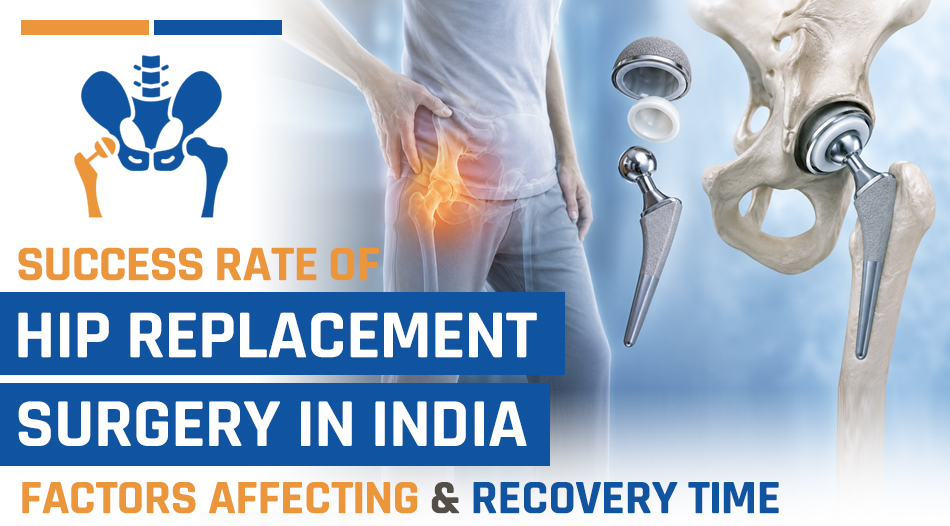
Hip Replacement Surgery Success Rate and Outcomes in India
It’s a common question among many patients. Before we define hip replacement surgery, it is equally important to know what a hip is. The hip is a ball-and-socket joint that connects the thigh to the pelvis. This joint helps you to walk, sit, run, climb stairs, and perform many other day-today activities.
During a hip replacement surgery, your orthopedic surgeon replaces your hip joint with a prosthetic implant. The surgical process takes around 2 hours for many patients.
Many patients recover well in 3 months. However, it may take 6 months or a year to fully recover.


Hip Replacement in India
For international patients, India has been amongst the top medical tourism destinations for hip replacement surgery. This is not only due to low cost but also high success rate and premium medical infrastructure at JCI- and NABH-accredited hospitals. Indian orthopedic surgeons are renowned for expert care and high patient recommendations. This is because top orthopedic surgeons in India perform high volumes of surgeries. This extensive experience makes them suitable for handling complex orthopedic cases.
Patients from Africa travel to India for hip replacement surgeries due to a paucity of expert surgeons, premium medical infrastructure, and high costs. Also, patients from the UK, USA, and Australia come to India due to long waiting times and very high costs at private hospitals. Even Middle Eastern patients come to India to receive expert care at accredited hospitals under expert surgeons.
Indications of Hip Replacement Surgery
- Hip symptoms make it difficult for you to do physical activities.
- Excruciating pain in the hip joints
- Stiffness and trouble in hip movement
- An injury that damaged your hip
- Hip arthritis
- Hip Dysplasia
- Physiotherapy or using a walking aid offers no relief
Patients with severe arthritis in multiple joints may also need knee replacement surgery.
Hip Replacement Success Rate in India
Indian studies have shown excellent functional outcomes following total hip replacement surgery, with improvements in pain relief, mobility, hip function, and quality of life. The Indian Society of Hip and Knee Surgeons (ISHKS) has also established a nationwide joint replacement registry that monitors implant performance, revision surgeries, and patient outcomes, supporting continuous quality improvement in arthroplasty care.

The preliminary ISHKS registry included data from 3,604 hip replacements performed by 42 surgeons across India. By June 2020, the Indian Joint Registry had expanded to 712 participating surgeons, tracking tens of thousands of joint replacement procedures to strengthen long-term outcome monitoring.
A prospective Indian study reported that 93.3% of patients achieved good or excellent functional outcomes one year after total hip replacement, with significant improvements in pain, mobility, and quality of life.
Another Indian study found that the Harris Hip Score improved from 38.8 to 90.4 after a mean follow-up of over seven years, with very few implant-related complications and good radiographic outcomes.
A prospective study from Jaipur also reported that the Modified Harris Hip Score improved from 13.3 to 88.5, with many patients returning to work and experiencing significant improvements in quality of life.
Factors Affecting Hip Replacement Success Rate
Below are the major factors that influence outcomes for hip replacement surgery.
- Your age affects long-term implant life.
- Healthy body weight improves long-term results.
- Choosing the right implant is important.
- Correct implant placement improves success.
- Strong bone support helps implants last longer.
- Preventing infection improves surgical outcomes.
- Hip stability reduces the need for another surgery.
- Avoiding fractures protects the new hip joint.
- Younger patients face higher revision surgery risk.
- Most revisions occur from aseptic implant loosening.
What Percentage of Hip Replacements Are Successful in India?
More than 90% of patients achieve good or excellent functional outcomes one year after total hip replacement. Most patients experience significant pain relief, better hip movement, improved walking ability, and an improved quality of life after surgery.
Top Hip Replacement Surgeons in India
India boasts of leading hip replacement surgeons who handle large volumes of patients with high patient satisfaction rates. While there are many expert and experienced surgeons, below is a list of leading names for patients who are looking for hip replacement surgery in India.
- Dr. Rajesh Verma — Best hip replacement surgeon in Delhi.
- Dr. Manoj Miglani — Pediatric Orthopedic Surgeon in India with more than 20 years of experience.
- Dr. Nitiraj Oberoi — More than 30 years as a joint replacement surgeon.
- Dr. Debasish Chanda — Expert in robotic-assisted hip surgeries and performed more than 4000 joint replacements.
- Dr. Pradeep B. Bhosale — Robotic Joint Replacement Surgeon in India with 40+ years of experience.
- Dr. IPS Oberoi — Expert and famous surgeon for hip replacement.
- Dr. Ashok Rajgopal — Last but not least, he needs no introduction. He is arguably the most experienced orthopedic surgeon in India and has 60,000 arthroscopic surgeries to his credit.

India has thousands of expert surgeons. However, we have curated this list for you based on experience, expertise, and patient recommendations. If you are looking for the best hip replacement surgeon in India, you can choose either Dr. Ashok Rajgopal or Dr. IPS Oberoi. If you are looking for the best robotic hip replacement surgeon in India, you can choose Dr. IPS Oberoi.
These above-mentioned surgeons practice in the best hip replacement hospitals in India that have premium facilities and robust medical infrastructure.
Hip Replacement Surgery Cost in India
The actual cost varies depending upon the following factors mentioned below:
- Partial Hip Replacement (best for older hip fracture patients)
- Total Hip Replacement (standard for severe arthritis or joint damage)
- Bilateral Hip Replacement (Both Hips)
- Robotic-Assisted Surgery (uses computer-guided precision)
- Revision Surgery (redo or complex procedures)
Your actual cost will also change depending upon the implant material, pre-surgery diagnostics, and room category. However, to give you a general idea of cost, unilateral hip replacement surgery in India costs around $4,500 and bilateral hip replacement surgery costs around $9,000.
If you want to know in detail about the cost, check hip replacement surgery costs and packages in India.
Is Hip Replacement a High-risk Surgery?
Generally, hip replacement is not considered a high-risk surgery. It’s a safe and highly successful procedure when performed by experienced surgeons. However, it also carries some risks like any other surgery.
- Infection, but it only occurs in less than 1% to 2% of patients.
- Blood clots may occur, but blood thinners and compression devices are routinely used.
- Dislocation but not reported in many patients.
- Leg Length Discrepancy
How Painful is a Hip Replacement on a Scale of 1 to 10?
Most patients rate hip replacement pain as around 4–7 out of 10 during the first few days after surgery. However, pain is well controlled with medications and gradually decreases over the following weeks. Most people notice significant pain relief and improved mobility as they recover.
Can You Live a Normal Life After Total Hip Replacement?
Yes. Most people can return to a normal, active life after total hip replacement. Once fully recovered, they can walk comfortably, climb stairs, drive, and perform most daily activities with little or no pain. However, high-impact activities such as running and jumping are usually not recommended to protect the new hip joint.
What is the 90% Rule for Hip Replacement?
After a hip replacement, the 90-degree rule means you should avoid bending your hip more than 90 degrees during the early recovery period, especially after a posterior hip replacement. This helps reduce the risk of hip dislocation while the tissues heal. Your surgeon may advise avoiding low chairs, deep sofas, and bending forward too far for the first few weeks.
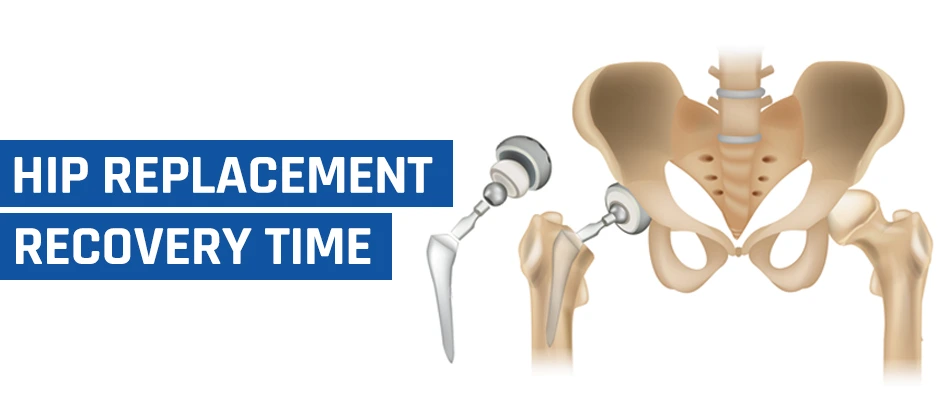
Hip Replacement Recovery Time
According to American Academy of Orthopaedic Surgeons (AAOS) and the National Health Service (NHS) patients should carefully plan their activities day-by-day and weeks. Find below total hip replacement recovery week by week.
| Timeline | Key Focus | Daily Actions & Precautions |
|---|---|---|
| Day 0 – Day 2 | First Steps & Discharge | • Walk with a walker/crutches hours after surgery • Practice basic ankle and leg exercises |
| Weeks 1 – 2 | Wound Healing & Swelling Control | • Rest, ice, and elevate the leg for swelling • Do physical therapy home exercises daily |
| Weeks 3 – 6 | Building Independence | • Resume driving (if off opioids & clear to do an emergency stop) • Avoid crossing legs or bending past 90 degrees. |
| Weeks 6 – 12 | Strength & Work Return | • Return to desk work (6–8 weeks) • Resume low-impact activities: swimming, walking, stationary bike |
| Months 3 – 6+ | Full Recovery & Sport | • Return to higher-level sports (golf, doubles tennis) • Avoid high-impact/contact sports (e.g., running, football). |
Note: Individual recovery rates vary depending on age, general health, surgical approach, and adherence to physical therapy. Always follow your orthopedic surgeon's specific post-operative protocol.
Many patients also go to a rehabilitation center after hip replacement surgery for guidance and recovery.
Hip Replacement Recovery Time for 70-year-old
For a 70-year-old, total hip replacement recovery usually takes 6 to 12 weeks to get back to normal daily routines. Most people can stand and walk short distances with a walker or crutches on the same day or the day after surgery. By 4 to 6 weeks, you can usually switch to a cane, walk comfortably, and resume light activities, while full muscle strength and total healing take about 6 to 12 months.
Lifetime Precautions after Hip Replacement
- Avoid high-impact activities like running, jumping, or heavy sports.
- Maintain a healthy weight to prevent early joint wear.
- Inform your dentist before procedures to get preventive antibiotics.
- Avoid extreme joint positions like twisting or forced hyperextension.
- Keep surrounding muscles strong with low-impact exercises like swimming.
- Use low-impact footwear with good arch support and cushioning.
- Listen to joint pain and consult your surgeon promptly.
What is the Best Method of Hip Replacement?
No single method is best for every single patient. The direct anterior approach allows faster early muscle recovery. The posterior approach offers excellent visibility for complex surgical cases. Robotic-assisted surgery improves implant placement precision and accuracy. The best method depends on surgeon expertise and patient anatomy.
When Can You Drive After a Hip Replacement Surgery?
- Usually between two and six weeks after surgery.
- Left leg surgery allows driving within 1–2 weeks.
- Right leg surgery requires four to six weeks.
- You must completely stop taking opioid pain medications.
- You must perform emergency stops safely without pain.
Average Age for Hip Replacement
Globally, the average age is around 65 years. Most patients receive surgery between 60 and 70 years old.
In India, the average age is younger (~52–60 years). Avascular necrosis causes earlier hip replacements in India. Younger patients under 50 increasingly undergo this procedure.
Hip Replacement Surgery FAQs
What can you never do after a hip replacement?
What are the reasons not to have a hip replacement?
How long after a hip replacement can I tie my shoes?
What is the physical therapy like after a hip replacement?
Is there back pain after a hip replacement?
Trending Blogs to Read
- Knee Replacement Success Rate and Cost Drivers in India
- IVF Success Rate in India
- Breast Cancer Survival Rate in India
- Epilepsy Surgery Success Rate and Outcomes in India
- Cochlear Implant Success Rate in India
- Success Rate of Penile Implant Surgery in India
References
■ Jose ML, Arunachalam AK, Karthik CA, Kumar SV, Diwahar MG, Rawat SS. Functional Outcomes of Total Hip Arthroplasty Using Modified Harris Hip Score and Oxford Hip Score: A Prospective Study. J Orthop Case Rep. 2026;16(6):150-155. doi:10.13107/jocr.2026.v16.i06.7408
■ Sidhu GAS, Kaur H, Singh H, Hind J, Ashwood N. Prospective Study Showing Results of Large-Diameter Femoral Heads After Cementless Total Hip Replacement. Cureus. 2021;13(1):e12610. Published 2021 Jan 10. doi:10.7759/cureus.12610
■ Lakhotia D, Agrawal U. Functional Outcome of Uncemented Total Hip Replacement in Low Socioeconomic Group Using Modified Harris Hip Score: A Prospective Midterm Follow-Up Study. Cureus. 2023;15(12):e50005. Published 2023 Dec 5. doi:10.7759/cureus.50005
■ Ulrich SD, Seyler TM, Bennett D, et al. Total hip arthroplasties: what are the reasons for revision?. Int Orthop. 2008;32(5):597-604. doi:10.1007/s00264-007-0364-3
■ Oltean-Dan D, Apostu D, Tomoaia G, et al. Causes of revision after total hip arthroplasty in an orthopedics and traumatology regional center. Med Pharm Rep. 2022;95(2):179-184. doi:10.15386/mpr-2136
■ Vaidya SV, Jogani AD, Pachore JA, Armstrong R, Vaidya CS. India Joining the World of Hip and Knee Registries: Present Status—A Leap Forward. Indian J Orthop. 2020;55(Suppl 1):46-55. Published 2020 Sep 16. doi:10.1007/s43465-020-00251-y
■ Pachore JA, Vaidya SV, Thakkar CJ, Bhalodia HK, Wakankar HM. ISHKS joint registry: A preliminary report. Indian J Orthop. 2013;47(5):505-509. doi:10.4103/0019-5413.118208





Be First To Comment
Leave a Comment