




Knee Replacement Success Rate and Cost Drivers in India
Around 790,000 people in the US undergo knee replacements every year. While 90% of them are successful, critical issues such as implant failures and complications also arise. Patients in the US also bear the heavy burden of knee replacement costs, which are priced 60%-70% higher than the costs in India.
Patients in African countries such as Nigeria, Kenya, Ghana, and Ethiopia also face even severe problems. High costs, lack of specialized surgeons, and delayed presentations with severe joint deformities are frustrating issues that patients face. Also, degenerative osteoarthritis is a concern, which makes the surgery very difficult. Studies indicate that around 77% of the patients undergoing knee replacement in Nigeria also have diabetes, hypertension, and heart disease. This creates additional pressure on surgeons performing surgeries. Lack of rehabilitation and proper data tracking are real issues that patients face across sub-Saharan Africa.
It won’t be an exaggeration to say that knee replacement in India offers some benefits, and India is one of the world's top destinations for knee replacement, driven by cost savings of up to 70–80% compared to Western nations, zero waiting periods, and the widespread availability of advanced robotic-assisted surgical systems.


Knee Replacement Success Rate
Research studies show that the success rate of primary total knee arthroplasty is 90% to 95% at 10 to 15 years after the surgery is done. However, the idea of actual success also depends upon the patient's blood sugar and BMI, as per the American Academy of Orthopaedic Surgeons (AAOS). Also, it is important to understand that roughly 15% of patients still experience some form of mild residual pain, stiffness, or a feeling that the knee doesn't feel entirely "natural," even though the X-rays look perfect as per the International Society of Orthopaedic Surgery and Traumatology (SICOT) and the European Federation of National Associations of Orthopaedics and Traumatology (EFORT). In fact, success is increasingly measured by patient perception, not just mechanical stability.

The European Federation of National Associations of Orthopaedics and Traumatology also mentions that component incompatibility is a major factor that determines success. While standard obesity doesn't hurt long-term movement scores, AAOS highlights that morbid obesity increases the risk of early wound healing issues and infections. Controlling blood sugar is widely considered to be a major determinant in measuring the effectiveness of knee replacements. Following implant safety regulations (per EFORT standards) is important for healthcare providers and surgeons.
What Does The Lancet Registry Data Say About Implant Longevity?
A landmark study was published in 2019 in Lancet that tracked 299,291 total knee replacements with more than 15 years of follow-up. It was a systematic review and meta-analysis of case series and national registry reports.
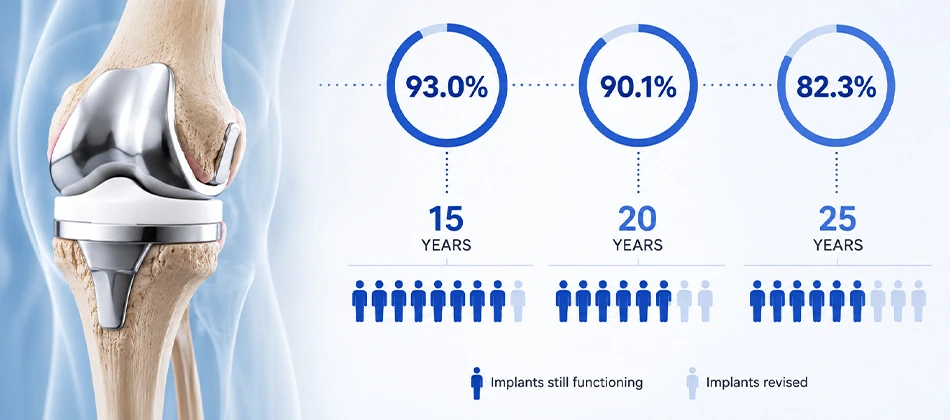
The study reported the following results:
- At 15 years: 93.0% of total knee replacements are completely intact and haven't required a revision surgery.
- At 20 Years: 90.1% of total knee replacements are still successfully functioning.
- At 25 Years: 82.3% (more than 4 out of 5) total knee replacements last a quarter-century.
Long-term implant survival has been extensively studied through national joint registries and systematic reviews. One of the largest analyses, published in The Lancet, combined evidence from national registries and long-term case series with more than 15 years of follow-up, providing a strong estimate of implant longevity.
It proved that the modern success rate and longevity of the surgery are higher than previously assumed. While the success rate is more than 90% at 15 years, complete pain relief and the "natural" feel of the knee consistently sit at approximately 80% to 85%. This nuance is important to understand for patients before making medical decisions.
How Successful is Knee Replacement in India?
A landmark study published by the Indian Journal of Orthopaedics involving 34,478 Total Knee Arthroplasties (TKAs) performed across India, the results were fascinating.
Unlike Western registries, where the male-to-female ratio is closer to 40:60, the Indian registry shows an overwhelming gender distribution: 75% of all knee replacements in India are performed on female patients, compared to just 25% on male patients.
Below are the important highlights of the study:
- Tracked in: Landmark ISHKS registry dataset,
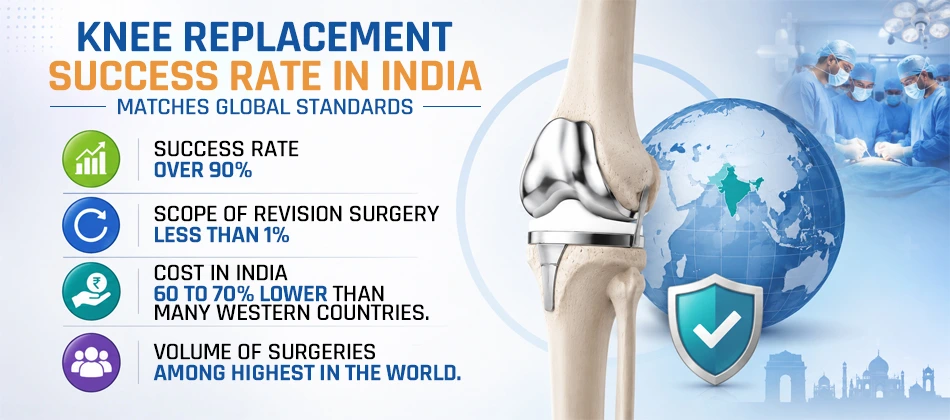
- Revision surgery: Out of the 34,478 total knee replacements tracked, only 281 required a revision surgery. It means that fewer than 1% of primary knee replacements required a corrective revision surgery.
Furthermore, localized clinical trials published in the Indian Journal of Orthopaedics reveal that 92.9% of patients achieve 'Excellent to Good' functional outcomes, with up to 97% reporting dramatic pain relief and restored mobility within the first few months of recovery.
Indian surgeons show a clear preference for mechanical stability, opting for Posterior Stabilized (PS) implants in 74% of cases to handle severe joint deformities.
However, when a knee implant does fail in India, the registry notes that Aseptic Loosening (mechanical ungluing of the implant from the bone) is the leading culprit at 64%, followed by deep joint infection at 26%.
Does Robotic Knee Replacement Improve Success?
Current research suggests that robotic-assisted knee replacement may improve the accuracy of implant positioning and reduce certain short-term complications. A large 2024 study involving 558,371 patients, published in the Archives of Orthopaedic and Trauma Surgery, compared robotic-assisted and conventional knee replacement surgery.
The study found that patients who underwent robotic-assisted surgery had lower rates of complications, including infection, blood transfusion, implant-related problems, and hospital readmission. They also experienced a slightly shorter hospital stay. Although robotic surgery generally costs more because of the technology involved, fewer postoperative complications may reduce overall healthcare costs in the long term.
However, robotic technology is only one factor. The long-term success of knee replacement still depends on surgeon experience, implant quality, patient selection, rehabilitation, and control of conditions such as diabetes and obesity.
What does it mean for international patients?
Mentioned below are some of the most convincing reasons why patients from the USA, Australia, and African countries choose India for knee replacements.
■ Matching Global Standards
India matches global standards for knee replacement success rate and exceeds many countries combined when it comes to volume. Research consistently shows that high surgical volume correlates with lower complication rates and better long-term implant survival.
■ Standardization of Global Implant Technology
The vast majority of leading Indian hospitals for knee replacement utilize the exact same implants from global manufacturers (such as Zimmer Biomet, DePuy Synthes, and Smith & Nephew) used in the US, UK, and Europe. You are receiving the identical, FDA-approved/CE-marked technology.
■ Expertise in "Complex" Arthroplasty
The top Indian surgeons for knee replacement frequently manage a higher volume of "neglected" or advanced-stage osteoarthritis cases Because of this, they have an exceptionally high level of expertise in managing severe deformities, bone stock deficiencies, and complex ligamentous balance. A famous name highly recommended is Dr. Vikram Shah — one of the best knee-replacement surgeons in India.
■ JCI Accreditation and Safety Protocols
The international patient should verify that their chosen facility holds JCI (Joint Commission International) accreditation. This is the gold standard for global patient safety and infection control. Top-tier Indian hospitals are accredited by JCI and NABH and follow patient safety guidelines.
■ Holistic Cost-to-Quality Ratio
This is not about "low cost"; it is about high-efficiency medical value. By reducing the administrative and non-clinical costs of care—while maintaining the same high-tier surgeons, global-standard implants, and surgical equipment—the financial model in India allows for the same clinical outcome at a fraction of the cost. The "success rate" remains the same; the pricing model is simply more efficient.
What Factors Can Affect Your Knee Replacement Success Rate?
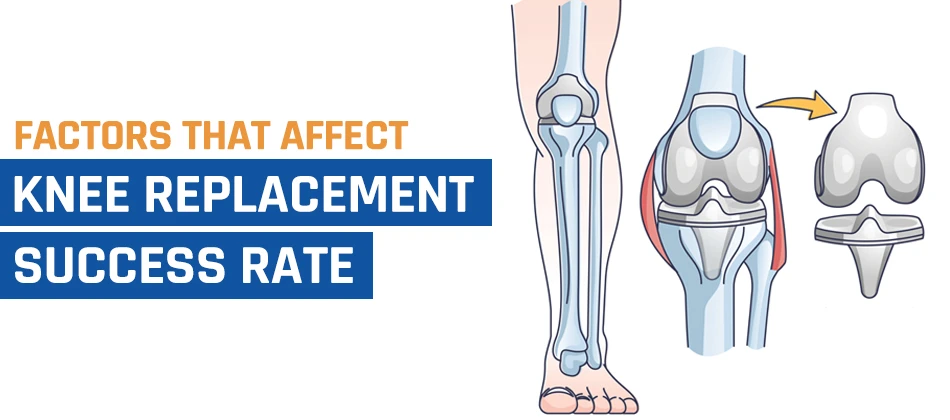
■ Glycemic Control: High sugar is one of the leading causes of Periprosthetic Joint Infection (PJI) that causes implant failure. Keeping fasting glucose levels under 126 mg/dL is important.
■ Morbid Obesity: AAOS data confirms that patients with a $BMI \ge 40$ face a higher relative risk of skin necrosis, delayed wound healing, and deep infection, which can compromise the implant's survival.
■ Hospital and Surgeon Volume: "High-volume" surgeons (performing more than 50–100 TK) As annual and high-volume institutions have significantly lower revision rates, shorter operating times, and fewer mechanical alignment errors compared to low-volume peers.
■ Component Compatibility (The "Mix & Match" Rule): The 1st EFORT European Consensus states that using a femoral component from one manufacturer and a tibial component or polyethylene liner from another is a direct catalyst for failure.
The 1st European Consensus issued by the EFORT Patient & Implant Safety Initiative (IPSI) explicitly emphasizes that component incompatibility is a major factor that determines early failure. Following these rigid safety regulations is crucial.
Things to Know Before Knee Replacement
Preparation directly impacts long-term success. Global orthopedic guidelines point to four critical pre-surgery benchmarks:
- Get Your Blood Sugar Checked: The American Academy of Orthopaedic Surgeons (AAOS) warns that high blood sugar causes deep joint infections. Aim for an $HgbA1c$ level under 6.5% before surgery.
- Fix Your Home Setup: You will need a clear path to walk. Remove loose rugs, install safety bars in your shower, and set up a chair that keeps your hips higher than your knees.
- Build Muscle Early: Doing gentle thigh exercises before surgery reduces the time you will spend in physical therapy afterward. Stronger muscles mean a faster return to normal walking.
- Know Your Implant: Top-tier hospitals in India use the exact same premium, FDA-approved global implants (like Zimmer Biomet or Stryker) that are used in the US or Europe. You are getting world-class technology.
Knee Replacement Recovery Timeline: What to Expect

Real recovery happens in phases. Based on data from The Lancet and large joint registries, here is the standard clinical timeline:
- Day 1: You will stand and take your first short steps with a walker within 24 hours of surgery. Early movement prevents blood clots.
- Weeks 1–2: Your main goal is to bend your knee to a 90-degree angle and straighten it completely. A physical therapist will guide you daily.
- Weeks 3–6: You will gradually switch from a walker to a cane, and eventually walk unsupported. Many patients return to desk work and driving during this window.
- Months 3–12: The deep joint pain is gone. You can enjoy low-impact activities like swimming and cycling. The joint will continue to feel stronger for up to a full year.
Top 5 Mistakes to Avoid after Knee Replacement
Avoiding these five common pitfalls keeps your recovery track aligned with the 90%+ long-term success rates seen in global clinical data.
1. Skipping Physical Therapy
Surgery fixes the mechanics of the joint, but therapy restores your actual movement. Skipping sessions allows thick scar tissue to form, which can cause permanent joint stiffness.
2. "Toughing Out" the Pain
Some patients avoid taking their prescribed pain medication because they fear dependency. However, unmanaged pain leaves your knee too stiff to move, which actively stalls your physical rehabilitation. Take your medication exactly as your doctor directs.
3. Pushing Too Hard, Too Soon
While movement is essential, overexerting your joint by lifting heavy weights or running too early strains the healing tissues and causes severe inflammation. Stick strictly to low-impact movements.
4. Letting the Leg Dangle
Sitting in a normal chair for hours allows fluid to pool in your lower leg. To reduce post-surgery swelling, you must elevate your leg on pillows so that your ankle rests higher than your heart level.
5. Ignoring Signs of Infection or Clots
Never stay silent if you notice abnormal symptoms. Call your surgical team immediately if you experience:
- A sudden fever or chills.
- Increased redness, warmth, or fluid leaking from the incision.
- New, severe pain or swelling in your calf muscle (a primary warning sign of a blood clot).
3 Essential Exercises for Early Recovery
Your physical therapist will prescribe a customized routine, but clinical protocols always begin with these three foundational movements to restore blood flow and muscle control:
■ Ankle Pumps
- How to do it: Lie flat on your bed. Point your toes straight down away from you, then pull them up toward your chin.
- The Benefit: Moves blood through your calf muscles to prevent deep vein blood clots. Perform this 10 to 20 times every single hour.
■ Thigh Squeezes (Quad Sets)
- How to do it: Lie flat and tighten the muscle on top of your thigh. Try to press the back of your knee firmly down into the mattress. Hold the squeeze for 5 seconds, then relax.
- The Benefit: Reboots the quadriceps muscle, which controls your ability to lock your knee straight and support your body weight when walking.
■ Heel Slides
- How to do it: Sit or lie on your bed. Slowly slide your heel backward toward your buttocks, bending your knee as far as comfortable. Slide it back out straight.
- The Benefit: Safely improves your knee's range of motion without putting weight on the new joint.
- A Quick Reality Check for Patients: Mechanical survival of a knee implant is incredibly high—over 90% at 20 years. However, absolute daily satisfaction sits closer to 80% to 85%. A successful surgery means your severe arthritic pain is gone and you can move freely again, but you should expect the joint to feel slightly different or "mechanical" compared to a healthy, natural native knee. Managing your expectations early is a key element of mental and physical recovery.
Knee Replacement Cost in India
The knee replacement cost in India varies by surgery type, hospital, and surgeon.
| Surgery Type | Cost (USD) | Hospital Stay | Key Details |
|---|---|---|---|
| Unilateral TKR (One Knee) | $3,500 – $4,200 | 3–5 Days | Standard primary replacement using a high-quality imported implant. |
| Bilateral TKR (Both Knees) | $6,500 – $7,800 | 5–7 Days | Performed simultaneously or sequentially during a single hospital admission. |
| Partial Knee Replacement | $1,800 – $3,400 | 2–3 Days | Resurfaces only the damaged compartment; faster initial recovery. |
| Robotic Knee Replacement | $9,000 – $10,000 | 7-8 days | Faster recovery, and longer-lasting implants |
| Revision Knee Surgery | $4,200 – $8,500+ | 5–8 Days | Highly complex; requires specialized revision implants and bone augments. |
The cost also varies by technological tier & implant selection. A procedure costing $4,500 to $6,000 in India typically costs $40,000 to $50,000 in the United States, offering an average savings of 80% to 90% without compromising on the quality of the implant hardware.
If you want to know in detail about the cost, please read Cost for Total Knee Replacement Surgery in India.
Knee Replacement FAQs
How long does it take to walk normally after knee replacement?
What is the hardest part of knee replacement recovery?
How painful is a knee replacement on a scale of 1 to 10?
Can you live with bone-on-bone knees without surgery?
Why no recliner after knee replacement?
What don't they tell you about knee replacement?
Word Bank: What Do These Big Words Mean?
- Osteoarthritis: When the soft, slippery cushions inside your joints wear away over time, causing the bones to rub together and hurt. Think of it like a tire on a bicycle losing its smooth rubber.
- Total Knee Arthroplasty: The official medical name for knee replacement surgery. It simply means taking out a broken, rusty joint and putting in a brand-new, smooth metal one.
- Implant / Hardware: The new, man-made knee parts. They are usually made of super-strong metal and smooth plastic that take the place of your old, worn-out bone.
- Revision Surgery: A "fix-it" surgery. If a new knee wears out after many years or has a problem, the doctor does a second surgery to change the old parts for fresh ones.
- Aseptic Loosening: When the new metal knee parts accidentally come unglued from the bone over time, without any germs or sickness causing it.
- Periprosthetic Joint Infection: A bad sickness caused by tiny germs getting inside the new knee area. Doctors track blood sugar closely to stop these germs from growing.
- Glycemic Control / Blood Sugar: A measure of how much sugar is floating around in your blood. Keeping this number low and steady helps your body heal much faster after an injury or surgery.
- BMI (Body Mass Index): A quick way doctors use a math rule to check if a person’s weight is healthy for how tall they are.
- Rehabilitation / Physical Therapy: Special exercises and movement games you do with a coach to teach your new knee how to bend, straighten, and walk perfectly again.
- JCI Accreditation (Joint Commission International): A special, high-value gold star given to hospitals. It proves that the hospital is incredibly clean, safe, and uses the best medical rules in the world.
References
■ Global Joint Longevity Study: How long does a knee replacement last? A systematic review and meta-analysis of case series and national registry reports with more than 15 years of follow-up. Published in The Lancet.
■ Official Treatment Guidelines: Surgical Management of Osteoarthritis of the Knee: Evidence-Based Clinical Practice Guideline. Published by the American Academy of Orthopaedic Surgeons (AAOS).
■ India National Data: Indian Society of Hip and Knee Surgeons (ISHKS) Joint Registry: A preliminary report. Published in the Indian Journal of Orthopaedics via PubMed / National Institutes of Health.
■ Robotic Knee Replacement Success Study: Outcomes following robotic assisted total knee arthroplasty compared to conventional total knee arthroplasty. Published in Archives of Orthopaedic and Trauma Surgery.
■ Implant Safety Framework: 1st European Consensus: Implant and Patient Safety Initiative (IPSI). Published by the European Federation of National Associations of Orthopaedics and Traumatology (EFORT).
■ Indian Registry Progress & Volume Growth: The Indian Joint Registry: Building Trust, Safety, and Excellence in Indian Orthopedics. Published in the Journal of Orthopaedic Case Reports via PubMed Central / National Institutes of Health.
■ Sub-Saharan Arthroplasty Outcomes: Total joint replacement in sub-Saharan Africa: a systematic review. Published in Tropical Doctor via PubMed Central / National Institutes of Health.
■ Complex Bilateral Indian/African Case Comparison: Staged versus simultaneous approach in complex bilateral total knee replacement: Experience from a tertiary institution in Nigeria. Published in the West African Journal of Medicine / Annals of Health Research via PubMed Central / National Institutes of Health.
■ US Surgical Volume Data: Joint Replacement Surgery Fast Facts. Published by the American College of Rheumatology.
■ Global Cost Dynamic Comparison: India vs USA Healthcare Costs: Real Comparison for Major Surgeries. Audited via the CureBridge Medical Network.





Be First To Comment
Leave a Comment