




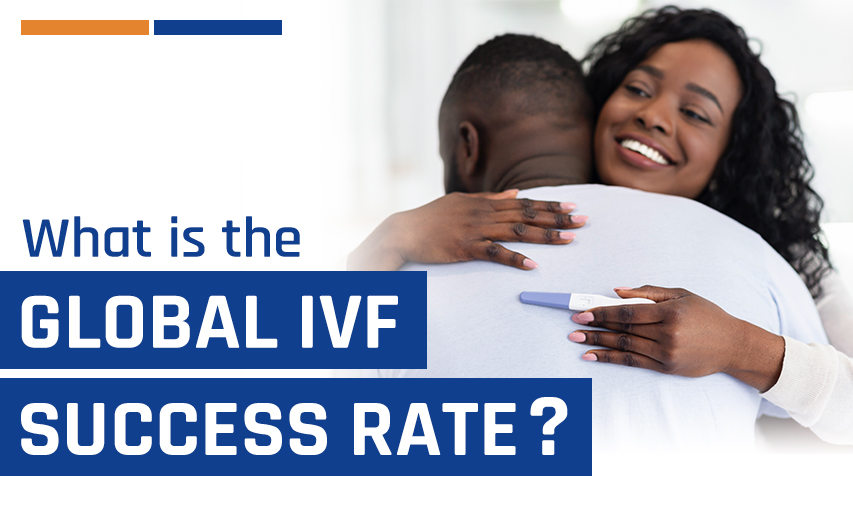
What are the Global IVF Success Rates for a Healthy Couple?
When the first baby was born through in vitro fertilization, it was hailed as a scientific triumph that gave hope to many couples struggling with infertility. Fast forward to 2024, and IVF has advanced rapidly, becoming one of the most popular treatments for infertility. However, when patients undergo in vitro fertilization treatment, one of their main questions is the likelihood of success—in other words, the IVF success rates for a healthy couple.


Up to 15% of couples trying to conceive struggle with infertility and face many challenges, often with no viable solution in sight. One potential solution to that problem is in vitro fertilization. IVF treatment in India not only addresses a wide range of causes of infertility in women and men. IVF is a process that involves extracting eggs from a woman's ovaries and fertilizing them with sperm in a laboratory. Once the eggs have been fertilized and developed into embryos, they are then transferred to the woman's uterus to achieve pregnancy.
It is therefore natural for couples considering IVF to be concerned about the success rate of the treatment. For those who want to know about the success rate of IVF for a healthy couple, this is the right place. In this blog post, we will explore the global IVF success rate for healthy couples and the factors that can affect the outcome of the treatment.
What is the Global IVF Success rate?
Depending on an array of factors, such as a couple's age, medical history, the proficiency of medical professionals, and the chosen clinic, the global success rate of IVF fluctuates. The success rate averages around 29%, according to the Centers for Disease Control and Prevention (CDC), signifying that only 29% of couples who undergo the treatment can successfully get pregnant, resulting in a live birth, out of 100 couples. With the specific factors discussed below, this percentage can change considerably.
Age greatly impacts the success of IVF, a complex procedure with a fine line between progress and failure. Essentially, older individuals are less likely to achieve positive outcomes than their younger counterparts. However, it partially affects because as women mature, the quality and supply of their eggs decrease, therefore lessening the chance of fertilization. Reportedly, women under the age of 35 have a success rate of around 40%, whilst women over the age of 42 have a mere 4-5% chance of achieving successful results, according to a Society for Assisted Reproductive Technology (SART) report.
The utilisation of donated eggs or sperm can potentially impact IVF success rates. If couples decide to incorporate donated gametes, their chances of IVF treatment might be dampened since determining the quality of the donor's eggs or sperm cannot be completely regulated. Moreover, a woman's age does not have as much of an impact on the IVF success rate when using donated eggs as it would when using their own.
Finally, it's important to note that the IVF success rates can also depend on the overall health and lifestyle habits of the couple, such as smoking, drinking, weight, and stress levels. Implementing healthy habits such as a nutritious diet, regular exercise, and stress-reducing activities can help increase the chances of successful IVF treatment.
What Are the Age-Related IVF Success Rates?
Age plays a huge role in deciding the IVF success rate for a couple. Let’s take a look at the IVF success rates by age range, why those rates drop with time and other variables that might affect the in vitro fertilisation process result.
■ IVF Success Rates Under 35 for a Healthy Couple
The Society for Assisted Reproductive Technology (SART) reports that among women under the age of 35, IVF results in 55.6% of live births. Births from the first embryo transfer for the in vitro fertilization success rate for a healthy couple succeed in 41.4% of cases. The likelihood of a successful live delivery drops to roughly 47% when embryos are transferred later. It's also worth noting that these numbers assume that the lady is utilising her eggs.
■ IVF Success Rates for Couples Between the Ages of 35 and 37
Women aged 35 and 37 have a 40.8% chance of success with in vitro fertilisation treatment using their eggs. After the first transfer of an embryo, the donor egg success rates by age 20-37 reach 32.4%. The success rate of a pregnancy climbs to 44.7% after a second or subsequent embryo transfer.
■ IVF Success Rates for Couples Between the Ages of 38 and 40
The IVF success rate for a healthy couple drops fiercely to only 26.8% for those aged 38–40. Only 22.3 per cent of women in this group had a successful live delivery after the initial embryo transfer. Women in this group usually have a live birth rate of 40.9% when attempting a second or subsequent embryo transfer.
■ IVF Success Rates Over 40 Years of Age
The IVF success rates over 40 years of age hover around 7% for women over the age of 40, whereas those under the age of 42 have a greater rate of IVF pregnancy than women over the age of 42. Women over the age of 40 often consider using donated eggs. Employing donor eggs in the IVF procedure shifts the reproductive advantage to a donor in her twenties, eliminating the age issue.
What Is The Difference Between Single Cycle IVF vs Multiple Cycle IVF?
The data presented above pertains to single egg retrieval IVF. Multiple-cycle IVF, on the other hand, focuses on increasing the chances of IVF success by undergoing several IVF attempts rather than relying on a single cycle to get the result you want.
The first in vitro fertilisation cycle has been shown to have a live birth rate of 29.5%, according to research published in 2015. Even after four tries, the success rate remained over 20%. By the sixth cycle, 65.3% of women had successful live births. The likelihood of in vitro fertilization success rate for a healthy couple rises with each additional cycle, even though earlier guidelines indicated completing just three or four cycles.
Multiple IVF rounds are challenging due to the high expense of the procedure and the emotional burden it places on the couple. Only a small percentage of couples, though, are capable or prepared to go through over three IVF cycles.
In Vitro Fertilisation Treatment Options
The IVF treatment options include:
1. Freeze-All Cycle IVF
Most clinics now use the freeze-all cycle IVF method in India. It involves freezing embryos produced by ICSI or traditional IVF rather than using eggs.
2. PGD Diagnosis
PGD diagnosis methods help physicians select the healthiest embryos for a successful IVF, which will help increase the IVF chances of success. Embryos may appear efficient on the surface but may lack key components necessary for pregnancy. On the other hand, embryos that seem less functional are more likely to contain everything needed for a healthy pregnancy. Doctors use PGD to identify, categorise, and choose the best embryos for continued development.
3. Endometrial Receptivity Analysis (ERA)
Patients who repeatedly experience implantation failure may benefit from this endometrial receptivity analysis IVF method, which aims to examine the endometrium at the molecular level.
4. Ideal Weight
A woman's fertility may be affected by her weight. Extreme thinness and severe obesity may cause disruptions in the normal process of regular and consistent ovulation. This makes maintaining a healthy weight important for fertility and for IVF success. You can achieve a healthy weight by making changes in food, activity, and exercise. You can also consider taking the help of a professional if your diet and exercise do not help you in gaining and losing weight.
5. Less Stress
Stress is a major factor in unsuccessful IVF attempts, which means learning to control your emotions is crucial. Many patients experience anxiety and stress after an IVF embryo transfer. The in vitro fertilization success rate for a healthy couple may be improved by reading comic books, watching funny movies, or creating a generally upbeat atmosphere at home that relieves stress.
6. Female Egg Quality
The IVF chances of success also depend on the number and quality of eggs in a female. Consuming multivitamins with vitamins D and C in a timely manner can increase the probability of in vitro fertilization treatment succeeding.
7. Good Hygiene
Bacterial overgrowth, itching, irregular vaginal discharge, urinary tract infections, and similar conditions can hurt the fertility of a woman. Proper vaginal and general hygiene can improve your chances of IVF cost and success rate for a healthy couple.
8. Good Sperm Health
The sperm count, or semen analysis, male fertility testing allows the doctor to evaluate the sperm count, morphology, and other attributes of the male partner. If a man has a low sperm count or quality, he must take vitamins and medications along with following a regular exercise routine, a balanced diet, and stress levels.
What Are The IVF Success Rates in India?
In India, the use of assisted reproductive technologies (ARTs) has been on the rise in recent years, making it a popular option for couples struggling to conceive naturally.
While the success rate of IVF varies depending on multiple factors, such as the age of the woman undergoing the treatment, the quality of the embryo, and the experience and competence of the medical team, it has been reported that the IVF success rate for a healthy couple in India is quite high.
In 2015, the Indian Council of Medical Research (ICMR) conducted a study on the success rates of IVF in India. According to their research, the fresh embryo transfer success rate was 43.1%, while the frozen embryo transfer success rate was 34.7%. Skilled medical personnel and advanced technology in India contribute to a high rate of success for IVF treatments. Various clinics employ top-notch techniques and state-of-the-art equipment for successful care. The plentiful number of highly trained embryologists is critical in the development of viable embryos and achieving successful pregnancies.
Thanks to its affordability, India boasts high in vitro fertilisation success rates. Compared to Western countries, IVF procedures within the country are marked by significantly lower costs that make them feasible for couples who would otherwise be unable to partake. By removing cost as a barrier, more couples have access to multiple rounds of treatment with excellent outcomes. IVF treatments in India are known for their high success rates and are available at affordable prices.
Infertility is a deeply emotional journey, and the IVF success rate for a couple can be influenced by various factors such as family support, relationship dynamics, religious views, lifestyle, and mental health. While statistical probabilities can provide guidance, it’s important to remember that you are more than just a number. The results of IVF are not always predictable, and your personal values and principles should guide your decisions throughout this process.




Be First To Comment
Leave a Comment